Letters
10
Who Credentials the Credential?
By
Navid Nathoo
The product of the education system is the credential. Not the learning, not the thinking, the credential. It's what students and parents are actually buying, and it's what universities, Coursera, and every bootcamp are actually selling. Strip away the language about growth and you find a transaction. You pay, you endure, you get a piece of paper that claims you can do something. The credential is the commodity. Everything else is packaging around it.
A credential has value because an institution stands behind it, and that institution is trusted because another institution stands behind it. So who credentials the credential? And who credentials them?
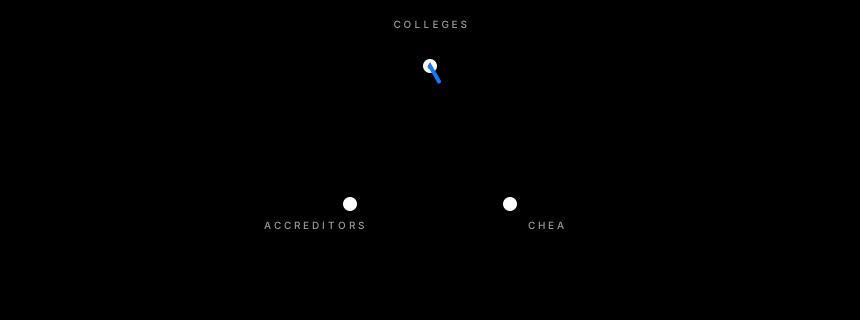
Follow the chain in the US and it gets strange quickly. Your degree means something because your university is accredited. Your university is accredited by an accreditor, usually one of a handful of regional commissions. Those accreditors are trusted because they're "recognized" by two bodies above them. One is the US Department of Education, which recognizes accreditors on the advice of a federal committee called NACIQI that reviews 63 agencies and makes recommendations to the Secretary. The other is CHEA, the Council for Higher Education Accreditation, whose job is literally to accredit the accreditors.
Now look at what CHEA is. It's an association of about 3,000 degree-granting colleges and universities. The schools fund it, and it blesses the accreditors, and the accreditors bless the schools. The loop closes on itself. The colleges pay into a council, the council approves the bodies, and the bodies approve the colleges. Nowhere in that circle is there an outside authority who actually knows whether a graduate can do anything.
It wasn't designed by anyone. The first accreditor, the New England Association of Colleges and Secondary Schools, was founded in 1885 by the colleges themselves, voluntarily, to distinguish real colleges from high schools. The federal government barely cared until the 1950s, when it started spending real money on higher education and needed a way to decide which schools could receive it. It could have built its own system to judge quality. It didn't. It reached for the private club the colleges had already built and made accreditation the gatekeeper for federal financial aid. So the thing that decides whether a college can touch billions in public money is a peer-review system the colleges run on themselves.
And it shows when you look at who sits on the commissions. One analysis found that 67% of accreditation commissioners have a potential conflict of interest, because they're employed by an institution their own agency accredits. The accreditors are membership organizations, funded by the schools they review. If an accreditor pulls a school's status, it loses a paying member. This is the body whose stamp turns four years and two hundred thousand dollars into a credential the world is supposed to respect.
The honest defense is that this is just peer review, and peer review is the best we've got. Who better to judge a college than people who run colleges? There's something to that. Expertise is real, and you do want knowledgeable people doing the evaluating. But peer review made sense when measuring the real thing was impossible, and a circle of insiders judging each other against standards they wrote themselves is built to preserve the system, not to test it. None of these people are oracles. They don't know which jobs will exist in ten years, they don't know what companies need now, and they certainly don't know what AI is about to do to every field they accredit. They're administrators maintaining a standard that drifts a little each year, and we've handed them authority over what counts as a capable human. I don't think we should trust them with it anymore.
We act like it's a law of nature that ability has to be vouched for by a third party. It isn't. There are whole domains where nobody asks for the paper.
Look at sports and gaming. There is no credential in either. There's only ability, measured directly. You can play basketball for ten years in your driveway and the NBA does not care, because the question isn't how long you played, it's whether you can play. Ben Wallace went undrafted out of a Division II school nobody had heard of, and became a four-time Defensive Player of the Year and a Hall of Famer, because the court doesn't read résumés.

Gaming is even cleaner. Arpad Elo built a rating system for chess where your number comes entirely from outcomes against other rated players. A player rated 100 points above another is expected to win about 64% of the time, and the math just tracks reality. Every competitive video game now runs a version of this. You don't submit a transcript to climb the ladder. You play, you win or lose, and the number tells the truth. These systems define ability through objectives and accomplishments, continuously, with no institution in the middle deciding you're qualified.
Education does the opposite. It measures time. Spend four years and you get a degree. Spend eight and you get an advanced one, and we somehow treat the extra years as proof of greater ability, as if sitting in rooms longer makes you better. Time is the currency you spend to earn the credential. And the thing that supposedly checks whether you've earned it is, for the most part, a multiple-choice test.
The dominant way we validate human ability is a format that can be scored by a machine in seconds. It's not that anyone thinks multiple choice is a good measure of capability. It's that it scales. Multiple-choice tests are cheap, fast, and objective to grade, which is exactly why they won, and they mostly measure whether you can recognize a correct answer, not whether you can do anything. The format that actually measures ability is the expert who sits across from you and grills you, follows your reasoning, pushes where you're weak, and watches how you think when there's no answer key. An oral exam by a real expert is the closest thing we have to truth. And it doesn't scale, because you can't put a domain expert in a room with every candidate on earth. So we gave up on measuring the real thing and credentialed the proxy instead.
Here's what changed. The reason we settled for credentials was a scaling problem, and the scaling problem just dissolved. AI can now do the thing that used to require an expert in a room. It can watch someone work through a real problem, probe their reasoning, judge the quality of what they produce, and do it for millions of people at once. The expert grilling, the only assessment that ever told the truth, is suddenly scalable. The entire case for trusting a credential rests on the assumption that you can't measure ability directly at scale. That assumption is now false.
This is why Zero has no tests and no credential. We don't ask a committee to vouch for you and we don't hand you a certificate. Instead, you do real work on real problems, and we watch four things while you do it: independence, speed, quality, and communication. Independence, because there's a difference between someone who needs a manager at every turn and someone who figures it out. Speed, because how fast you work is a real signal of how well you understand it. Quality, because the work has to be good. Communication, because in real work the person who can't communicate doesn't get far no matter how sharp their thinking. From those four, we can tell whether you're ready for the job, the way a colleague who's actually worked with you could tell.
And because it's based on ability instead of time, it doesn't run on a clock. One person might be ready in two months. Another might take two years. That's the point. People don't grow at the same rate, and two people who spend the same four years are not equally capable at the end of them. A system built on time has to pretend they are. A system built on demonstrated ability doesn't have to pretend anything.
So I don't think the answer is a better accreditor, or a new council to credential the new schools. The answer is to stop needing the credential. When you can show directly what a person can do, the question of who blessed the paper stops mattering, the same way it never mattered on a basketball court or a chess board. The credential was always a workaround for a problem we couldn't solve. We can solve it now. Zero isn't trying to become the next thing the old system blesses. It's trying to show that the blessing isn't necessary anymore.
Navid Nathoo
Founder, Zero