Letters
9
Human Inference
By
Navid Nathoo
Training is when an AI model learns. Inference is when it runs, taking new inputs and producing outputs. Most of the money in AI went to training first, but lately the conversation has shifted. How fast can a model reason? How cheaply can it reach the right answer? What happens if you give it more time to think before responding? A lot of the recent gains in AI capability haven't come from better training. They've come from better inference.
The same distinction exists for humans, and we've been ignoring the second half of it.
Human "training" is what happens in school: acquiring knowledge, building skills, absorbing information. We've built elaborate systems for this. Sixteen years of compulsory education, trillions in institutional spending, entire industries of curriculum and testing. And then inference, the ability to take what you've learned and reason well from it in novel situations, is mostly left to chance.
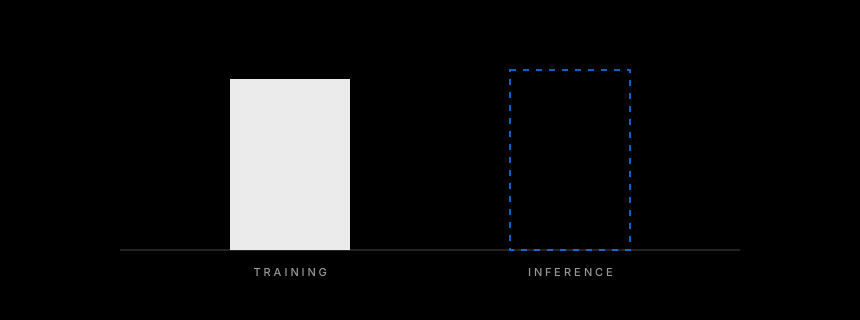
Human inference is harder to pin down than machine inference, but you recognize it when you see it. It's the person who walks into an ambiguous situation and draws the right conclusion from thin evidence. The person who reasons backward from outcomes to causes, or forward from first principles to cases nobody anticipated. The person who knows when to trust a pattern and when to ignore it. Two people with identical information can produce wildly different results. The difference is usually inference.

We treat inference capacity as fixed. Intelligence, the kind that shows up on standardized tests, gets measured at 18 and then taken as given. It follows a person for decades. We treat it like height, something you have rather than something you build.
I think this is wrong. The biggest discovery in frontier AI over the past two years is that inference-time compute changes outcomes dramatically. Give a model more processing time, let it reason through a problem in steps before committing to an answer, and it gets measurably smarter. The model's intelligence isn't fixed. It scales with how it's allowed to think.
The same turns out to be true of humans. Metacognition (thinking about your own reasoning) is trainable, and people who develop it systematically make better decisions. Working on problems slightly beyond your current ability builds inferential capacity over time. Learning across multiple domains improves the ability to draw analogies, which is a lot of what good inference actually is. None of these show up in a curriculum, but they show up reliably in outcome differences between people.
The obvious objection is that AI inference and human inference aren't comparable, that one is matrix multiplication and the other involves consciousness, emotion, and all the rest. I'd accept that if the claim were that they work the same way. The claim is simpler: that reasoning quality is variable and improvable in both cases, and that treating it as fixed in humans is a mistake we can correct.
The AI industry has spent roughly a trillion dollars making machine inference better. We haven't built anything equivalent for humans. Schools teach content. They don't teach people to reason about content. Assessment tests what you recall. It doesn't test how well you reason when recall fails. The entire architecture of human development is oriented toward loading the model, and almost nothing is oriented toward improving what happens when the model runs.
The human blueprint includes the capacities that govern inference: how people reason under uncertainty, how they update when evidence contradicts what they believe, how they avoid the systematic errors in judgment that compound across a lifetime. None of these appear in a standard curriculum, not because they don't matter, but because they can't be tested on a standardized test. They're the substrate everything else runs on.
Investing in human inference is harder than investing in human knowledge. Knowledge is transferable, measurable, and easy to credential. Inference capacity builds slowly, through the right kinds of practice, and most of that practice doesn't look like education. It looks like working on hard problems, reasoning through real decisions, and being wrong enough times to notice the pattern in your errors.
But that difficulty isn't a reason to ignore it. AI companies have learned that a model with high inference quality on modest training beats a model with weak inference on enormous data. Reasoning quality matters more than knowledge quantity, past a threshold. That same relationship holds for humans. We've spent 150 years optimizing training and almost nothing on inference, and the gap is about to matter a great deal more.
The world is spending billions figuring out how to make machines reason better. Someone should be building the equivalent for humans.
—
Navid Nathoo
Founder, Zero