Principles
1
Figuring It Out
By
Navid Nathoo
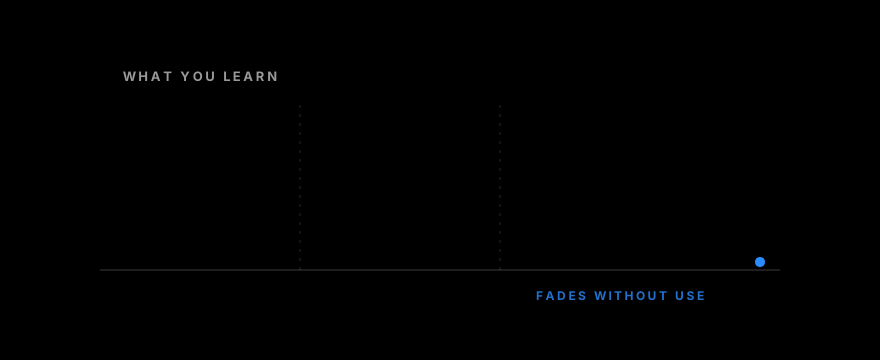
Almost everything you learn has a half-life. The tool you master gets replaced, the workflow you memorize gets redesigned, and the specific knowledge that makes you useful this year is half obsolete by the next. This was always somewhat true, and AI has made it brutally true. So the most valuable thing a person can carry across a career isn’t any particular content. It’s the ability to walk into something they’ve never done and figure it out.
That’s the skill Zero is built to train, and it shapes how the whole product works. Every scenario is drawn from the real world, with real projects and real workflows, and most people meet them having never done the thing before. We don’t hand over step-by-step instructions. We keep it ambiguous on purpose, the way a manager does in actual work. You get the general direction and the goal. What you don’t get is a recipe.
So you have to drive. If you don’t know what the deliverable should look like, it’s on you to ask what they’re looking for. If you don’t know the requirements, you ask for the requirements. If you don’t know how to do something, you ask how. If a word or a concept goes by that you don’t understand, you stop and ask what it means. Nobody is going to spoon-feed you the next move, because nobody does that at real work either. The person who waits to be told stays stuck. The person who drives gets somewhere.
This isn’t a free fall. Each scenario is broken into stages, and each stage is a real deliverable you hand to a manager for feedback. You get guidance that sets you back on the path when you’ve wandered off it. We also know that every person arrives calibrated differently, with different experience and different gaps, so the experience meets you where you are. But the guidance never turns into a script. You’re still the one steering. The manager reacts to where you’ve driven. They don’t drive for you.
The reason I keep insisting on this is that the skill of figuring things out matters more than the content you figure out along the way. I’d go further. In a world this unstable, it’s the part of an education with the longest shelf life. The mindset of facing an ambiguous situation with confidence instead of freezing, and the habit of knowing which questions to ask and in what order, don’t expire when the tools change. They’re what let you pick up the next unfamiliar thing fast, and then the one after that.
The obvious objection is that you can’t figure out a field you know nothing about, that content has to come first and ambiguity without knowledge is just flailing. There’s something to it. You do need to know things. But you pick up the content along the way, in service of a real problem, which is exactly how you’ll acquire everything you ever learn after school ends. Knowledge you go and get because you need it sticks. Knowledge delivered for its own sake is gone by the exam. The content isn’t skipped in Zero. It’s earned in the order real work hands it to you, as the thing standing between you and a result you’re trying to reach.
What you walk out with is a person who isn’t thrown by not knowing. Drop them into a new tool, a new workflow, a new domain, and they don’t wait for instructions that aren’t coming. They start asking. The specific things they learned in Zero will date. The way they learned them won’t.