Principles
2
Proof of Understanding
By
Navid Nathoo
AI has made it easy to look like you know what you’re doing. You can produce a working model, a clean deck, a finished analysis, and hand it over, and most people can’t tell whether you understood a word of it. That’s the obvious risk, that you can fool other people. The subtler and more dangerous one is that you can fool yourself. Watching something get made in front of you feels like understanding it. It isn’t. And the gap between the two stays invisible until the moment you have to do it without the AI, which is usually the moment that matters.
So understanding is the thing we protect in Zero, and we built a system for it called proof of understanding. It shows up in different places across the product, and its job is simple. At each point where it would be easy to produce work you don’t actually grasp, it makes sure you do. You can use AI the whole way through. You just can’t coast past the point of understanding what it did.
The reason this matters comes down to two ways of using AI, and they look alike from the outside. In the first, you have something to do, so you ask the AI to do it, take what comes back, and move on. In the second, you have something to do, and before you reach for the AI you form a plan. You decide what outcome you’re driving toward. You know what good looks like. Then you use the AI to help you get there, steering it, correcting it, throwing out what misses. The first path is fast and it usually produces slop. The second produces something worth having, and the better you understand what you’re aiming at, the better the result. AI is a lever, and a lever does nothing without a person who knows which way to push.
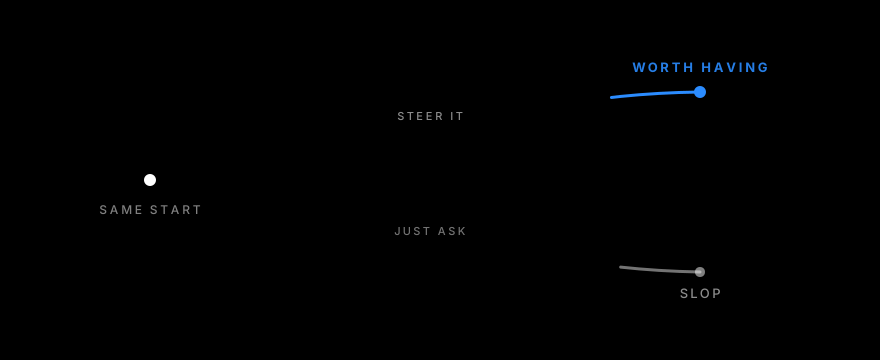
This is why being able to produce something and understanding it aren’t the same, and why we refuse to treat them as the same. A person who can only generate output is at the mercy of whatever the model hands back, with no way to tell good from bad. A person who understands the work directs the model toward an outcome they’ve already pictured. We built proof of understanding so that every user is the second person, driving the outcome and using AI to support it, rather than the first person hoping the output is fine.
You might object that this is just friction, that if the AI can produce the deliverable, forcing the human to understand it makes people redo work the machine already did. But the deliverable was never the point. The point is the person who walks out the other side. Slop scales beautifully and it’s worth nothing, because the moment the problem shifts even slightly, the person who didn’t understand the last one is helpless. Understanding is what transfers. It’s what lets you handle the next problem the AI hasn’t seen.
And that’s what we’re building toward. As a user moves through the scenarios in Zero, their understanding compounds, because they’ve had to understand each step rather than wave it through. So by the time they’re sitting in a job interview, and then doing the job itself, they can actually do it. Not because they memorized it, and not because an AI carried them, but because they understood the work the whole way through. Anyone can produce the work now. The people who understand it are the ones who’ll still be worth hiring.