Principles
4
What You Made and What They Said
By
Navid Nathoo
Strip away the lectures and the campus and the four years, and university comes down to one function. It tells the world you’re competent. The degree is a proxy for ability, and employers accept it because they need some way to judge people they’ve never seen work. The trouble is that a degree is a bad proxy. So is a resume. So is a report card. None of them show what a person can actually do. They show that someone sat through the right things in the right order, which is a different claim, and increasingly not the one anyone cares about.
If you wanted to genuinely represent what a person is capable of, there are really only two things worth looking at. What they produce, and what the people who’ve worked with them say about them. Everything else is a stand-in for these two, and a worse one. So those are the two things we built Zero around.
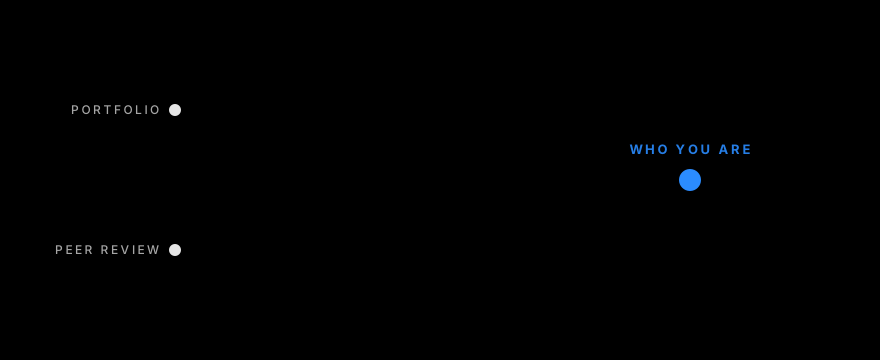
The first is the work itself. As you move through the scenarios, you build real deliverables, and you present them to your team the way you’d present work to colleagues. Those deliverables and presentations become a portfolio. A recruiter or hiring manager can open it and see the actual projects you’ve worked on, how you present them, how clearly you communicate, and how well you understand what you built. That’s a far richer picture than a GPA. A transcript tells someone you passed. A portfolio shows them what you can make and lets them judge for themselves.
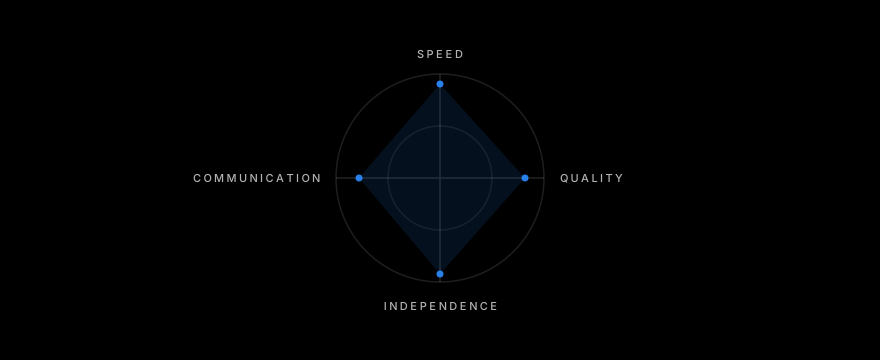
The second is what your coworkers say, and this is the part that’s been missing from every resume ever written. In each scenario you work alongside AI teammates, and they evaluate you the way real colleagues would, on four things. Speed, because how quickly you work is a real signal of how well you understand it. Quality, because the work has to be good. Independence, because there’s a difference between someone who needs the manager at every turn and someone who figures it out alone. And communication, written and spoken, because in real work the person who can’t communicate doesn’t get far no matter how good their thinking is. Your teammates watch all four as you go, and at the end you get a performance review, with feedback at each stage, telling you where you were strong, where you were weak, and exactly what to do about it.
That feedback is worth more before the real world than after it. Most people learn what matters in a workplace only once they’re in one, by getting it wrong in front of an actual boss. By the time someone leaves Zero, they’ve already had the reviews, already found out that their communication was lagging or their independence was thin, and already worked on it. And a hiring manager can see those reviews too, so they aren’t taking your word or your school’s word for your ability. They’re seeing it through the eyes of the people who worked with you, which is the lens employers trust most and almost never get before they hire.
The obvious objection is that AI coworkers aren’t real, that a machine’s review of you means nothing. I’d agree if the AI judged on machine criteria. It doesn’t. We built these teammates to look at exactly what a human colleague looks at, because we modeled them on how real people size up the people around them. The difference is that they observe everything, every interaction across every scenario, which no human reference has ever done for you. A reference letter is one person’s faded memory. This is a continuous record of how you actually work.
So Zero doesn’t answer whether you have the credential. It questions the credential itself, and measures directly what degrees have tried (and failed) to do. What can this person make, and what is it like to work with them? Show that, and the degree has less to add.