Principles
5
What Good Looks Like
By
Navid Nathoo
The first move in learning anything isn’t doing. It’s seeing. Before you produce a single thing, you have to know what good looks like, and why it’s good. You can’t make something exceptional starting from a blank page, because you don’t yet know where you’re going. You’re working toward a result you can’t picture, which means you have no way to tell whether you’re getting closer to it or further away.
Once you can recognize what good looks like, learning becomes a question of getting there. You replicate it. You find the workflows and the steps that move your own work toward that standard, and you keep closing the gap until what you make is close to the thing you admired. Only then does it make sense to get creative. You can’t surpass a standard you’ve never reached, and you can’t reach a standard you’ve never seen.
So that’s where every scenario in Zero begins. For each one, we show you an example of what good looks like, and we explain why it’s good. You see the finished deliverable and the heuristics underneath it, the variables that make it work, so you understand the thing you’re aiming at and why it works. It shows up first in the kickoff meeting, where your manager walks you through the example the way a real manager would brief you on a project. And it stays with you. At every stage, for every deliverable, you keep referencing what good looks like, so the target never goes blurry. You always know the outcome you’re driving toward.
Then you go and produce it, and the evaluation system that judges it is flexible, not a rigid rubric of boxes to tick. If you beat the baseline, you score higher, and your own quality bar rises with you. If you fall below it, you get feedback on how to close the gap, and then suggestions on how to push past it, the same way a good manager tells you both what you missed and how to be better next time. We can do this because there’s an AI evaluation system at the core, and it can read intent and improvement. It can tell when someone is exceeding expectations, when someone is meeting them, and when someone is falling short of the baseline.
We reverse-engineer the standard from the real world. We look at what good actually is in the workforce today, and we train two things at once: the specific deliverable, and the heuristics behind why it’s good. The deliverable teaches you the target. The heuristics teach you to hit a new one on your own, because once you understand the variables that make something good, you can apply them to work you’ve never done before. The goal is always to exceed the standard. But even if you only meet it, you walk out genuinely job-ready, because the baseline itself was set by what the job requires.
This is top-down learning, and it’s the opposite of how almost everything else teaches. The traditional system builds from the bottom up. You learn one small piece, then another, then another, and somewhere far down the line the pieces are supposed to assemble into competence at a real thing. It’s slow, and worse, it’s disorienting, because you’re collecting parts without ever seeing the whole they belong to. Top-down flips it. You look at the outcome first, you understand what makes it good, and then you work backward to build the knowledge and the know-how to produce it. The content still gets learned. It just gets learned in service of a result you can already see, which is the order that makes it stick and the order that makes it fast.
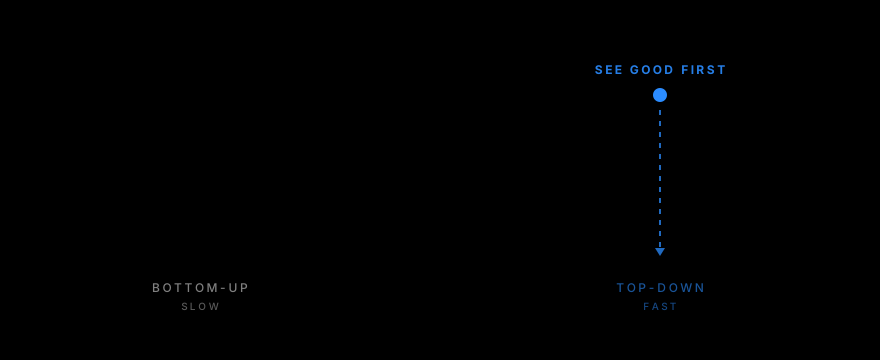
And I think the traditional system is crazy inefficient. It assumes you need four years before you can contribute, as if time were the input that produces capability. I don’t think time is the factor. Humans are malleable, adaptive, and smart, and what holds them back is the systems we design for them to learn through. Give a person a system that starts at the end state, shows them what good looks like, and gives them real feedback against it, and they get good in a fraction of the time the old system assumes they need.