Principles
6
Skills That Matter
By
Navid Nathoo
It isn’t enough to train people for a job. Being great in a role takes more than the tasks of the role. It takes a set of underlying skills that impact how well you work, how you fit into a team, and how far you go. No one has clearly mapped what those skills are, how to train them, and how to measure them.
We’ve mapped the skills that have the highest impact across careers and roles, and they come down to six categories that fall into two major buckets. One is the skills specific to your role, the actual work you’re hired to do. The other is everything around the work, navigating people and situations. Most education and training focuses on the role-specific skills and ignores the rest, even though the rest is often what separates people who plateau from people who keep rising. Zero trains and measures both.
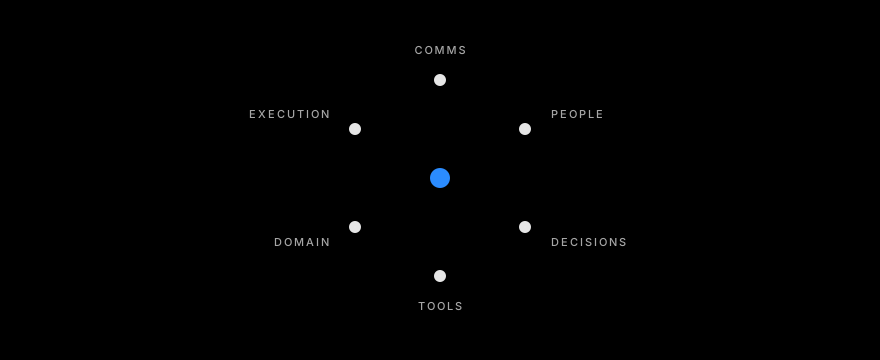
The first is communication, and it’s foundational. Nearly everything else you do depends on it, and now that means communicating with AI as well as people. It splits into three: verbal communication, written communication, and presenting. Almost every role runs on these, and a person who can’t communicate stays capped, no matter how good their thinking is.
The second is people skills. This is collaboration, conflict management, negotiation, and leadership, and there are more we’ll build out over time. These are the skills for working through other people rather than alone, and they’re the hardest to teach because they only show up in real interactions with real friction. You can’t learn to manage conflict from a textbook. You learn it by being in one and navigating through it, which is exactly what our scenarios put you in.
The third is decision-making, and it comes in three forms that need different muscles. There’s logical decision-making, where you have a bunch of data and one clear decision it points to. There’s decision-making under ambiguity, where you don’t have enough information, and the skill is knowing how to go get what you need. And there’s decision-making through people, where the answer depends on stakeholders who each want different things, and you have to understand every one of their motivations to choose well. Most real decisions are some mix of the three, and people are rarely trained in any of them.
The fourth is execution ability, the skill that gets results. One side of it is figuring things out. Hand someone a problem they’ve never seen and see whether they can work their way to a solution. The other side is building. Can they prototype, make, ship the thing? Plenty of people can talk about what should exist, and far fewer can actually build it, which is why that gap is one of the most valuable things to measure.
The fifth is domain skills, the ones specific to your role. A marketer needs copywriting. A software engineer needs to understand database architecture, and increasingly prompt engineering. These don’t transfer across jobs the way the others do, but within a role they’re the technical core. And they keep changing, faster now than ever because of AI. The best practices and workflows in a role are always moving, so being good at your domain means staying in the loop with how the work is done today, not how it was done a few years ago. Zero trains the ones that map to the work you’re actually trying to do.
The sixth is tool fluency, and I think it’s more important than most people realize. We live in a technology-driven world, and tools are the lever that lets one person do the work of several. That lever keeps getting longer. How well you know your tools correlates directly with how much you can produce and how good your output is. A few decades ago this was just computer fluency. Could you use email, Word, Excel, PowerPoint? The people who could do more, faster. Now the tools are far more advanced and there are far more of them, so knowing which one to reach for counts for even more. A software engineer who’s fluent in Cursor, Claude Code, Supabase, and Vercel outbuilds one who isn’t. A marketer who knows Higgsfield, Claude Cowork, and MCPs outproduces one who doesn’t. And because most of these tools are now AI-enabled, fluency in them is what makes someone AI-native. An AI-native employee is more productive and effective than one who isn’t, and that gap is only going to widen.

So the six are communication, people skills, decision-making, execution ability, domain skills, and tool fluency. Zero develops and measures every one of them, and it does it inside scenarios built to mimic the real world, with real managers, real deliverables, and real projects.
The way to think about Zero is as an operating system, not a technology platform or a learning platform. An OS can run on a laptop, inside a company, or inside a school, and any human layer can sit on top of it. You can use Zero alone in its pure software form. You can layer IRL environments and coaches on top. You can plug it into a company or an institution. It works in all of these because what matters is the architecture underneath.