Letters
7
The Compounding Human
By
Navid Nathoo
The defining chart in technology is a compounding curve. Each model generation builds on the last, capability stacks, and the entire industry is organized around the assumption that this continues.
Draw the same chart for a typical human and you get a curve that rises until about age 22 and then goes flat. We even discuss human capability in the vocabulary of depreciation, where skills get outdated, knowledge gets stale, and degrees age. We built a system where a person's capability peaks at the moment the system stops, then erodes for decades.
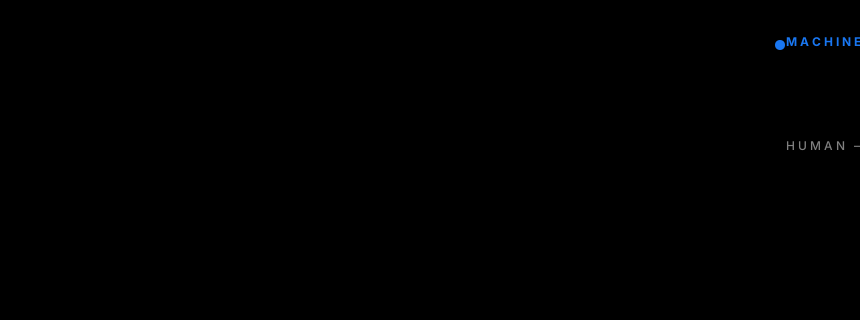
Nothing about that shape is biological. It's what you get when nobody designs anything. Human capability can compound the way technology does. Each skill makes the next cheaper to acquire, each solved problem expands what you can attempt, and the growth feeds itself. Some people already live on that curve. We call them outliers and assume they're built differently.
I think they're mostly not. Watch what outliers actually do, and the differences between people look less like differences in talent than differences in compounding rate. The person who learns how to learn compounds faster than the person who memorizes. The person who picks problems slightly beyond their ability compounds faster than the one who stays comfortable. The person surrounded by ambitious peers compounds faster than an equally talented person surrounded by passive ones. None of these are gifts. All of them are trainable, and all of them can be built into an environment.
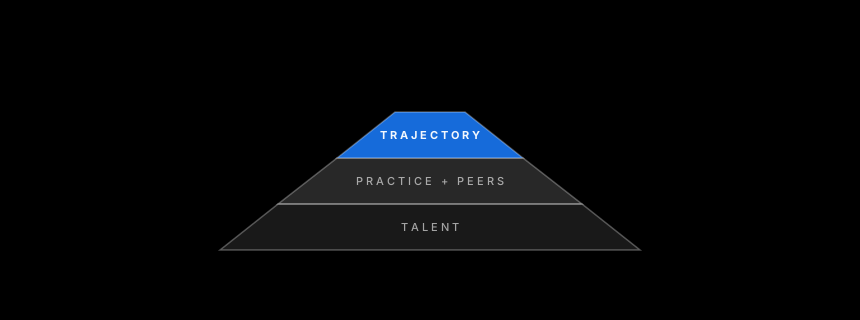
The obvious objection is that talent is real. It is. But talent sets the starting point and compounding sets the trajectory, and over a 60-year working life, trajectory dominates. A modest starting point compounding at a high rate passes a brilliant one that flatlined at 22, usually within a decade.
No institution is architected around increasing a person's compounding rate. Schools transfer information. Universities credential. Employers consume current capability and book training as a cost. Zero is built around exactly that number. How fast is this person's capability growing, and what would raise the rate? The blueprint defines what compounds. The operating system makes it continuous. The environment supplies the problems, the stakes, and the peers.
This matters beyond any individual, because most anxiety about AI reduces to the gap between the machine curve and the human flat line. You don't close that gap by slowing AI down. You close it by bending the human curve upward. And for investors, every dollar in AI is a bet on the machine curve, while nobody yet owns the human one.
—
Navid Nathoo
Founder, Zero