Letters
6
Short-Term Incentives, Long-Term Humans
By
Navid Nathoo
If you want to understand why the education system produces what it produces, ignore the mission statements and look at the incentives. Every stage of the pipeline optimizes for the next checkpoint. Elementary school optimizes for middle school placement, high school for college admissions, college for the diploma. At no point does anyone optimize for the human and the life they're going to live. The checkpoints were meant to measure development. They became the target instead, and the development became optional.
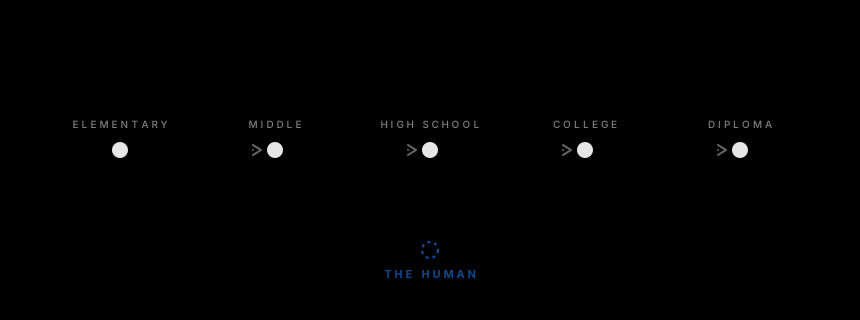
Markets call this managing to the quarter. A company that games its quarterly numbers can look great while hollowing itself out, and a student can do the same by memorizing, testing, and forgetting. The result is sixteen years of strong reported earnings while the person's actual capability never gets built. The grades were real, but the growth they were supposed to measure never happened.

The deeper cost is what this trains people to believe. Sixteen formative years of working toward grades teaches you that work exists to clear checkpoints, that questions come with answer keys, and that someone else decides what matters. You get the humans your incentives design. We designed for test-takers, and then we wonder why people who can think for themselves are scarce.
Why does it stay this way? Because institutions drift toward what's measurable. Grades are legible; capability historically wasn't. So the whole apparatus organized itself around the legible thing, and the gap between what's measured and what matters widened every year. That, at least, is changing now that capability is becoming measurable, which removes the system's main excuse.
But without grades, how do you know anyone is learning? The same way the world outside school already knows. Nobody asks about a founder's GPA. The market evaluates what you can do, continuously, and the work itself is the assessment. School is the only place where we felt the need to invent a parallel scoring system, and the parallel system is what broke.
Zero runs on real capability demonstrated in the real world, because that's the one metric that compounds. There are no grades to game and no checkpoints standing in for growth. Incentives are the real curriculum. Design them for the short term and you get test-takers. Design them for the human and you get humans.
—
Navid Nathoo
Founder, Zero