Letters
3
The Human Blueprint
By
Navid Nathoo
Everything we build starts with a spec. Before anyone writes code or bends metal, someone defines what the thing must do and designs backward from that. We do this for phones, bridges, and rockets. We've never done it for humans.
The closest thing we have is the school curriculum, and the curriculum was never designed. It accumulated, picking up some 19th century industrial training, some leftover classical education, and whatever subjects got added when a committee grew nervous (geometry stayed, Latin mostly left, computer science took fifty years to arrive). The result is legacy code that has been patched for 150 years and never rewritten. No one alive sat down with a blank page and asked what a human needs to thrive in this century.
So we did. We mapped how a capable human thinks, how they decide under uncertainty, how they learn new domains quickly, how they create, how they work with others, and how they recover when things go wrong. We call it the human blueprint. It's a model of a person rather than a list of subjects, and the difference turns out to be enormous. Most of what's on the blueprint is taught nowhere. Most of what's taught in school isn't on the blueprint.
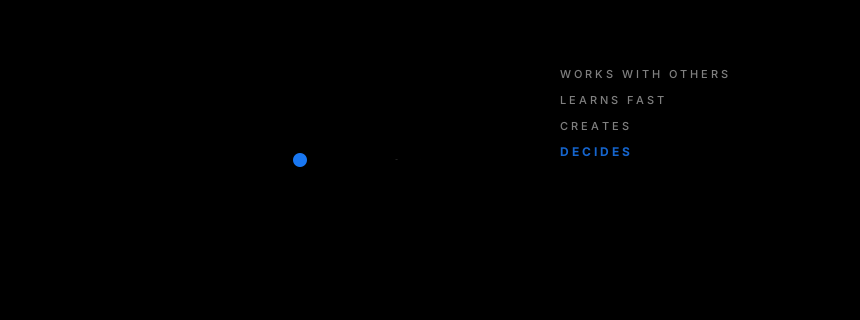
A reasonable person will object that humans aren't machines and can't be specced, that people vary too much for one blueprint to fit everyone. But a blueprint isn't a mold. We're not defining what every person should become, only the capacities a person draws on to become anything. And those capacities vary far less across people than goals do. Everyone needs to make good decisions. Not everyone needs organic chemistry.
Starting from a blueprint instead of a curriculum inverts the whole architecture. You stop asking whether someone passed the test and start asking whether they can do the thing. You stop measuring seat time and start measuring capability. You stop organizing development by subject and start organizing it by what this particular person needs next.
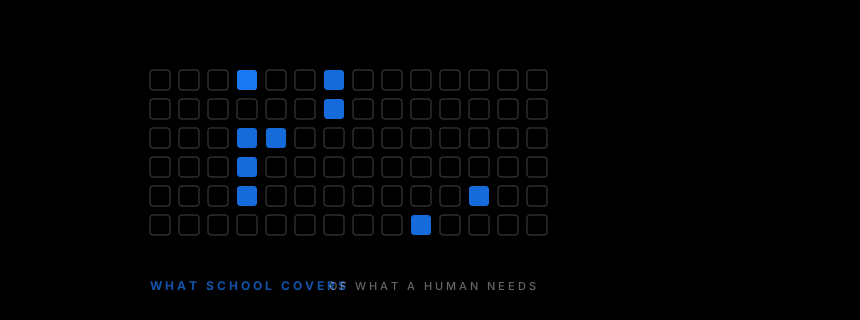
This is the deepest reason Zero isn't a school. Schools start from subjects and hope a capable human emerges at the end. We start from the human. It sounds like a small change in starting point. It changes everything downstream.
—
Navid Nathoo
Founder, Zero