Letters
4
An Operating System for Humans
By
Navid Nathoo
An operating system is a persistent layer that manages resources, runs programs, and improves with every update. Software gets one. Humans get a one-time installation that runs from age five to twenty-two, then stops, leaving you on your own for the next sixty years.
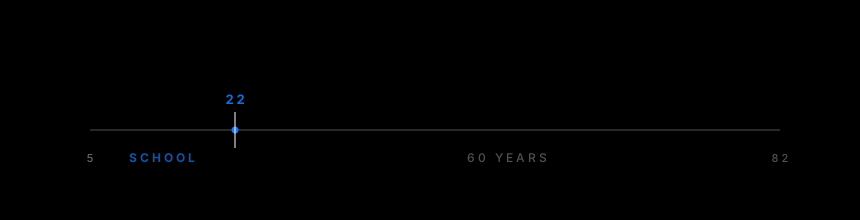
That design made sense when skills lasted a working lifetime, when you could learn a profession in your twenties, practice it for four decades, and retire. For most of the 20th century the assumption roughly held, so front-loading all development into the first quarter of life was defensible.
The assumption no longer holds. By some estimates, around 39% of a person's current skills will be outdated or transformed within the next five years. In a world like that, development that ends at 22 is a structural error, whatever the quality of the schooling. The problem isn't only that school teaches the wrong things (though it often does). The problem is that growth was designed as a phase of life, and it now needs to run for all of it.
And no one owns that layer. We built persistent systems for money (banks), for health (medicine), for information (the internet). For human development, the asset that determines what a person can do and earn and become, the system switches off in early adulthood. Adults who want to keep growing assemble something themselves out of courses, books, bootcamps, and YouTube, which is roughly how people managed money before banks existed.
You could object that the demand isn't there, that most adults don't want continuous development. The evidence says otherwise. People already spend enormous amounts on upskilling despite being served by fragments. What they can't buy anywhere is a system that knows where they are in their development, manages growth the way an OS manages resources, and updates as the world changes. The demand exists. The infrastructure doesn't.
Zero is built as that layer, on the human blueprint, running on demonstrated capability rather than credentials, and designed for the length of a life rather than the length of a degree.

This also answers the market size question. Sized as education, Zero competes for tuition and edtech budgets. But the real market is what individuals, companies, and countries will pay for humans who keep growing across a 60-year working life, and education spending only covers the first 22 years of it, badly. Edtech sells courses into the old system. We're building the layer that replaces it.
—
Navid Nathoo
Founder, Zero