Letters
1
Long Humans
By
Navid Nathoo
This series of essays was inspired by Thrive Holdings post titled "Long Humans".
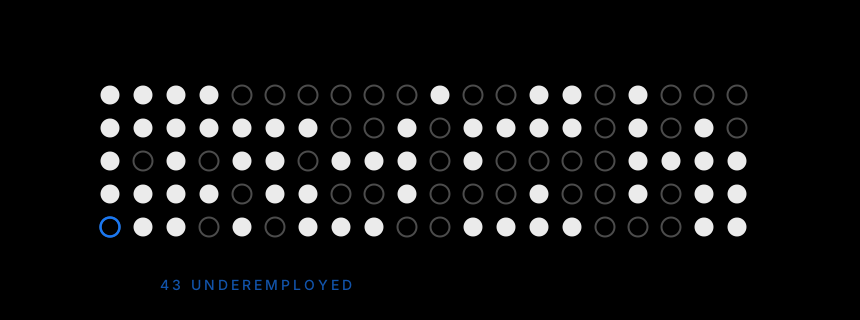
Look at where capital is flowing and you can read the world’s position on humans. Trillions are going into compute, data centers, and models. At the same time, entry-level job postings have fallen about 35% since 2023, and roughly 43% of recent graduates are underemployed. The market is long AI and short humans. No one placed this trade deliberately; it emerged from millions of individual decisions about where to put money and attention.
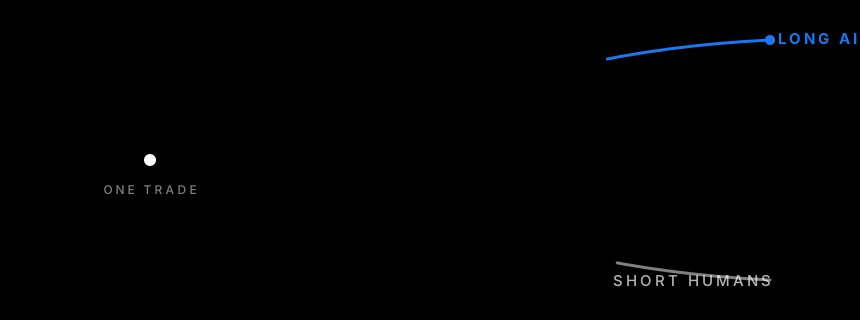
I think the short side of the trade is wrong. Every major technology wave so far has been followed by infrastructure for humans. Industrialization needed workers who could read and follow processes, so we built public schooling. The knowledge economy needed specialists, so we scaled universities. The technology came first, and then someone built the system that prepared humans to be valuable alongside it. And in each case, that second system became one of the defining institutions of its era.
The AI wave has no such system yet. We have the most powerful technology in history and human development systems designed for the previous era. Schools still train people for an economy of stable jobs and stable knowledge, and that economy is gone. So the gap between what humans are trained for and what the world needs is widening, while the money that could close it flows to the other side of the trade.
A fair objection is that this time the technology may replace humans rather than complement them, in which case building infrastructure for humans is wasted effort. I’d take that seriously if value were staying in tasks. It isn’t. As AI absorbs well-specified work, the value of a human concentrates in deciding what’s worth doing, in judgment under uncertainty, and in figuring things out when no specification exists. Those capabilities get more valuable as AI gets better, and almost nothing is being invested in producing them.
The most valuable resource in the world is not oil or gold. It’s human potential. But resources don’t extract themselves. Oil sat underground for millions of years until someone built drills, pipelines, and refineries. Human potential sits inside billions of people right now, and the extraction systems we’ve built for it (schools, degrees, multiple choice tests) recover a small fraction of what’s there.

Everyone understands what AI infrastructure means. We’re spending trillions on data centers, chips, and power so machine intelligence has what it needs to grow, and entire industries exist to supply it. Ask what the equivalent is for human intelligence and you get silence. Nobody is building it. That’s what Zero is, and human infrastructure is the most accurate name for it. It starts with a blueprint of what a capable human is made of, a system that develops those capabilities continuously, and an environment that keeps them compounding for life. AI infrastructure prepares machines for the future. Human infrastructure prepares humans for the same future, and right now only one of them is getting built.
Zero is the long position. When everyone crowds one side of a trade, the other side gets cheap. Humans have never been cheaper to bet on, and the case for betting on them has never been stronger.
The world is short humans. We’re long.
—
Navid Nathoo
Founder, Zero